Water Heater Leak Cleanup in Anaheim, CA
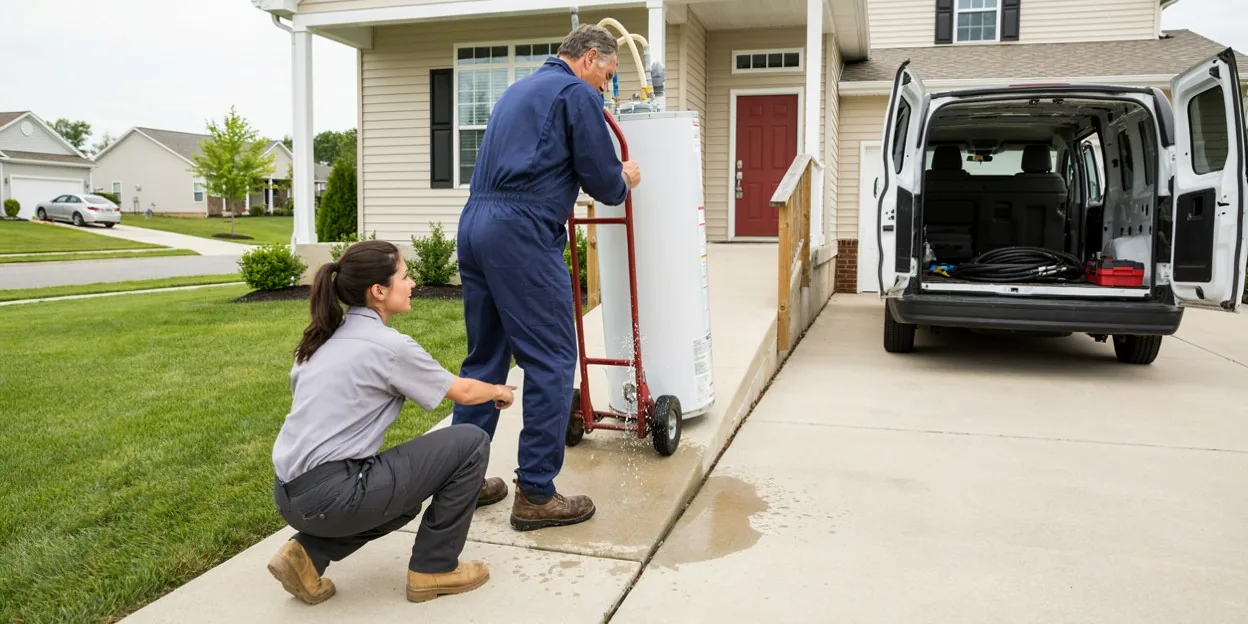
You went out to the garage for the recycling and stepped into water. The forty-gallon tank on the stand in the corner is weeping from the bottom seam, the boxes on the floor are soft, and when you went back inside the carpet in the bedroom on the other side of that wall was wet along the baseboard. This site puts you through to an independent local provider who cleans up after water heaters in Anaheim and across north Orange County.
Two directions at once: across the garage and through the wall
A garage water heater in an Anaheim tract stands against a wall it shares with a bedroom, a bathroom, or the laundry, and the garage slab is usually a step lower than the house. So the water does two things at once. It spreads across the garage floor toward the door, and it soaks through the bottom of the shared wall into the room behind it. The crew meters the garage wall, then goes inside and meters the same wall from the other side, plus the floor along it. A closet heater in a hallway is worse, because every direction is living space and the carpet runs right up to the platform.
The crew also checks whether the tank sat in a drain pan and whether that pan had a line to the outside. In most of the older tracts it did not, and the pan filled and overflowed just like the tank.
Shut the cold inlet and the gas before you touch anything else
Turn the valve on the cold pipe above the tank clockwise until it stops; that cuts off the supply feeding the leak. Set the gas control to off, or trip the breaker if the tank is electric. Do not try to drain the tank yourself if the floor around it is wet and the outlet is nearby. Get the boxes and anything on the floor up onto shelves or out onto the driveway, and photograph the garage, the water line on the wall, and the wet carpet inside before you move anything. Then call. A plumber replaces the tank; the restoration provider dries what the old one soaked.
Bare concrete dries; unpainted garage drywall does not
Bare concrete in a garage dries in a few days once the water is off it and air is moving. The drywall on the garage side of the shared wall usually comes out from the floor up to the water line, because garage drywall is unpainted and wicks like a sponge. On the house side, the baseboard comes off and the drywall gets metered; if it is wet only at the base it can often dry in place with holes drilled behind the baseboard line. Carpet along that wall is lifted and the pad replaced. Then structural drying finishes the wall and the floor on the meter.
If the tank let go somewhere other than a garage, in a hall closet or a laundry room, more of the floor is involved, and the first step is usually water extraction across the hallway and the rooms it opens onto.
Hard water, scale, and a tank that quits at nine years
Water heaters here fight the same hard water that eats slab copper. Scale builds on the bottom of the tank, the burner overheats the steel under the scale, and the glass lining cracks. A tank that might last twelve years on soft water gives up at eight or nine on Anaheim groundwater, and the first sign is usually a puddle, not a sound. Most of the ranch houses built from the 1950s through the 1960s have the heater in the garage on a wooden stand, often with no pan and no drain line, because the code did not ask for one when the house went up.
Earthquake strapping is required on every tank in California, and a tank that was never strapped can shift on the stand and crack a fitting, which is a slower leak and harder to notice. In Anaheim Hills the heater is often in a closet inside the house or on the second floor, where a failed tank soaks a ceiling and the room below along with the closet.
A sudden tank failure is usually treated as sudden damage under a California homeowners policy, while a tank that dripped for weeks may not be. The new heater itself is almost never covered. This site cannot read your policy and promises nothing about it. Have the crew photograph the tank, the pan, and both sides of the wall before anything comes out.
When you call about a weeping tank
Say where the heater is, whether the water is off, whether the garage or a closet is wet, and whether the room on the other side of the wall is damp. Mention if the tank is gas or electric and whether a plumber is already coming. Keep the address and a callback number handy for the person who answers. Call (657) 239-3689.